Understanding Factor Pairs in Math: A Comprehensive Guide

What are Factor Pairs?
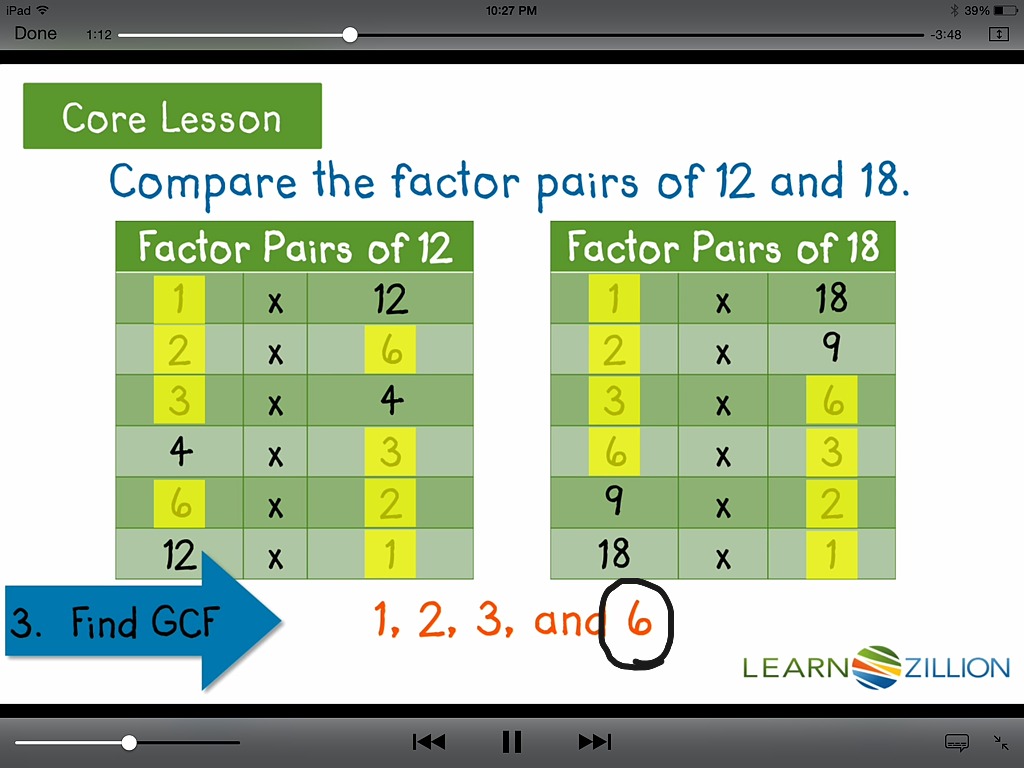
Factor pairs are a fundamental concept in mathematics that can help you solve a wide range of problems, from simple equations to complex algebraic expressions. In essence, factor pairs are two numbers that multiply together to give a specific product. For example, the factor pairs of 12 are (1, 12), (2, 6), and (3, 4), because 1 x 12 = 12, 2 x 6 = 12, and 3 x 4 = 12.
Understanding factor pairs is crucial in math, as they can help you simplify equations, find the greatest common divisor (GCD) of two numbers, and even solve quadratic equations. Factor pairs can also be used to find the missing factor in an equation, making it easier to solve problems and find the solution.
How to Find Factor Pairs
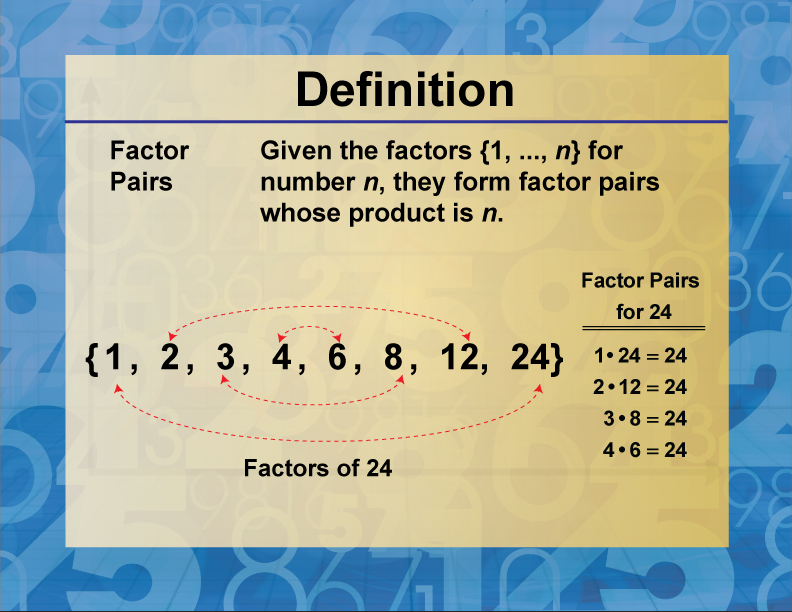
What are Factor Pairs? Factor pairs can be defined as two numbers that have a product equal to the original number. For instance, the factor pairs of 24 are (1, 24), (2, 12), (3, 8), and (4, 6), because 1 x 24 = 24, 2 x 12 = 24, 3 x 8 = 24, and 4 x 6 = 24. Factor pairs can be used to solve a wide range of math problems, including finding the area of a rectangle, the volume of a cube, and even the solution to quadratic equations.
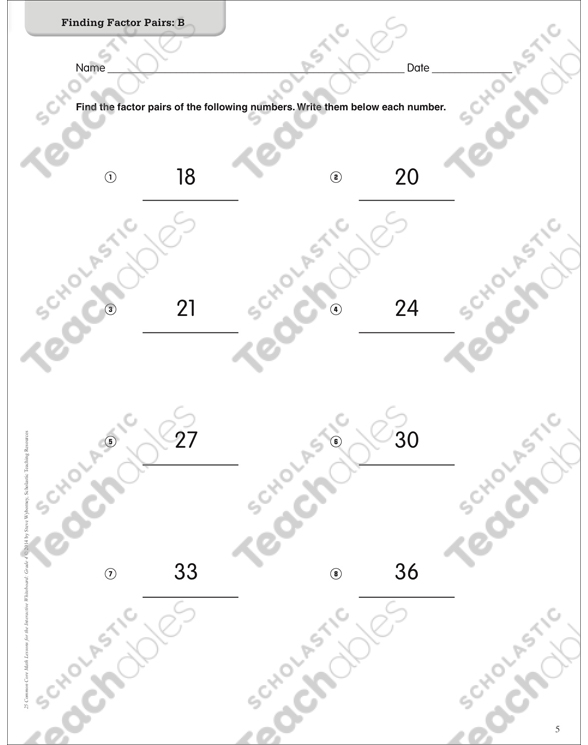
How to Find Factor Pairs To find factor pairs, you need to identify the numbers that multiply together to give the original product. You can start by listing all the factors of the number and then pairing them up. For example, to find the factor pairs of 36, you can list all the factors of 36, which are 1, 2, 3, 4, 6, 9, 12, 18, and 36. Then, you can pair them up to find the factor pairs, which are (1, 36), (2, 18), (3, 12), (4, 9), and (6, 6). By understanding factor pairs and how to find them, you can become more proficient in solving math problems and equations.