Mastering Fractions: A Guide to Adding Fractions with Unlike Denominators


Understanding the Basics of Adding Fractions
Adding fractions with unlike denominators can be a challenging concept for many students. However, with the right approach and practice, it can become a breeze. In this article, we will explore the basics of adding fractions with unlike denominators and provide a comprehensive guide on how to master this skill. Whether you are a student, teacher, or parent, this article is designed to help you understand and apply the concept of adding fractions with unlike denominators.
To add fractions with unlike denominators, you need to find the least common multiple (LCM) of the two denominators. The LCM is the smallest number that both denominators can divide into evenly. Once you have found the LCM, you can convert both fractions to have the same denominator, and then add them together. For example, if you want to add 1/4 and 1/6, you need to find the LCM of 4 and 6, which is 12. Then, you can convert both fractions to have a denominator of 12: 1/4 = 3/12 and 1/6 = 2/12. Finally, you can add the fractions together: 3/12 + 2/12 = 5/12.
Practicing with Worksheets: A Key to Success
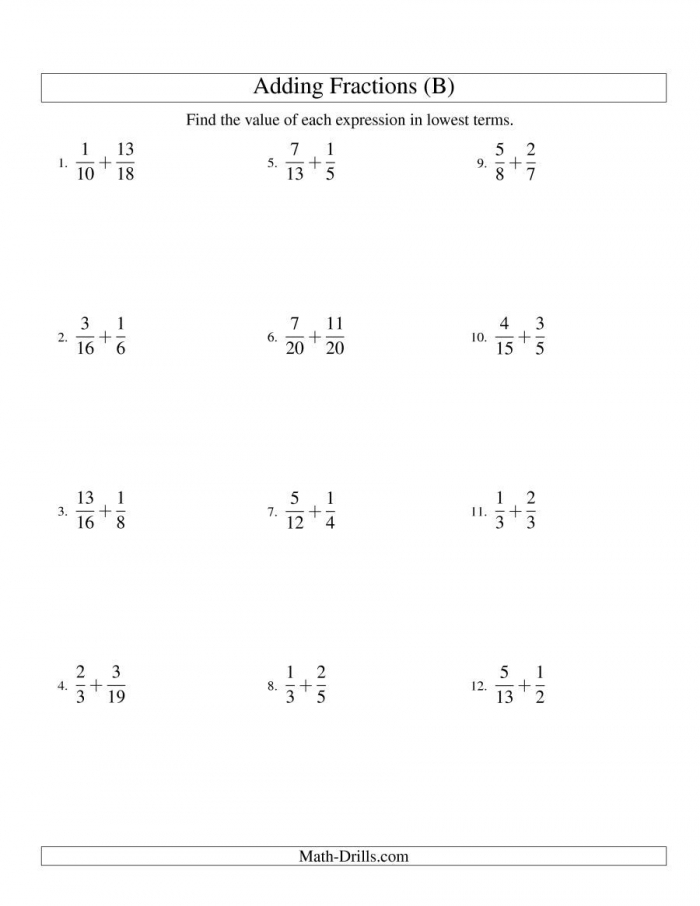
Now that we have covered the basics of adding fractions with unlike denominators, let's talk about how to practice this skill. One of the best ways to practice adding fractions with unlike denominators is by using worksheets. Worksheets provide a comprehensive and structured approach to learning, allowing you to practice a wide range of problems and examples. By using worksheets, you can identify areas where you need to improve and track your progress over time. Additionally, worksheets can be a fun and engaging way to learn, making the process of mastering adding fractions with unlike denominators enjoyable and rewarding.